Names and locations have been changed to protect privacy. Akiko has given her full permission for this interview to be published.
Hello! I'm Hillary, a researcher here at Cicely. A big part of my work involves talking to people about their real, everyday experiences of moving through the world, specifically the buildings, streets, transport systems, and public spaces that most of us pass through without a second thought. Because those spaces were not designed with everyone in mind, and the people who feel that most acutely have some of the most important things to say about it.
This is the first in a series of interviews I'm conducting with people who navigate the built environment in ways that are rarely reflected in how that environment gets designed or evaluated. Today's interview is with Akiko, a woman who has been fully blind since birth, grew up in rural Hokkaido, and now works in a corporate role in Tokyo. We spoke for about an hour over video call, and I want to share as much of that conversation as possible because almost every part of it taught me something.
I met Akiko four years ago at seven in the morning on a street in Montreal. I was late, half-awake, already anxious about the seminar I was rushing to, when I spotted her standing outside a building she hadn't been to before, trying to work out where the entrance was. She is fully blind, and the building was new to her. I walked over and helped her find the entrance, and we ended up in the same classroom. That was the beginning of one of my closest friendships and one of the most interesting ongoing conversations I've had about what access and independence actually mean in practice.
Choosing a school at six: mainstream school or a school for blind students
I started by asking Akiko about her education, because she had mentioned before that she spent her entire childhood in Japan's special needs education system and I wanted to understand what that actually looked like from the inside.
In Japan, children with disabilities are often given a choice between attending a mainstream school with support, or attending a special needs school designed specifically for students with their particular disability. That choice sounds straightforward. In practice, as Akiko explained, it is anything but.
Hillary: “How long were you in special needs education?”
Akiko: “From primary school until high school. So twelve years.”
Hillary: “Did you get to choose between mainstream school and special needs school?”
Akiko: “I had to decide when I was six. My parents made most of the decision, but I remember visiting the mainstream school. Teachers spoke as if I could see. I felt left out and uncomfortable, so I chose the special needs school.”
From primary through to junior high, Akiko had no classmates at all. For nine years, she was the only student in her class.
Akiko: “When I started junior high school, I began wondering whether it was okay to feel comfortable in a school for blind students. My teacher stayed the same for three years and often told me that I should interact more with people my age. But I didn't have classmates. I had no way to meet people or communicate with peers. I started to feel the limitations of my environment.”
The system gave her specialist support, proper Braille instruction, teachers trained to work with blind students. And in doing that, it also made her completely alone.
Moving to Tokyo at fifteen: Braille, orientation and mobility, and wayfinding by landmark
Hillary: “Is that why you decided to move to Tokyo for high school?”
Akiko: “Yes. I moved far away from my family to attend a high school for blind students in Tokyo. When I entered, there were eighteen classmates with different types of visual impairments. I lived in student accommodation.”
Hillary: “What did you like about living alone as a high school student?”
Akiko: “There were many opportunities for daily living training. It was valuable to learn essential skills like doing laundry, washing dishes, cleaning the bathroom, bathing independently. I also learned specialised skills. Students in mainstream schools often fall behind in Braille or orientation and mobility. Through my classes, I mastered walking techniques, such as how to avoid bumping into utility poles and how to identify landmarks.”
That answer is worth sitting with, because it describes wayfinding as a skill people are trained into rather than something a building provides. Akiko learned to read a street through landmarks, tactile paving, kerb edges and sound, because very little of the environment announces itself to a blind or visually impaired person on its own.
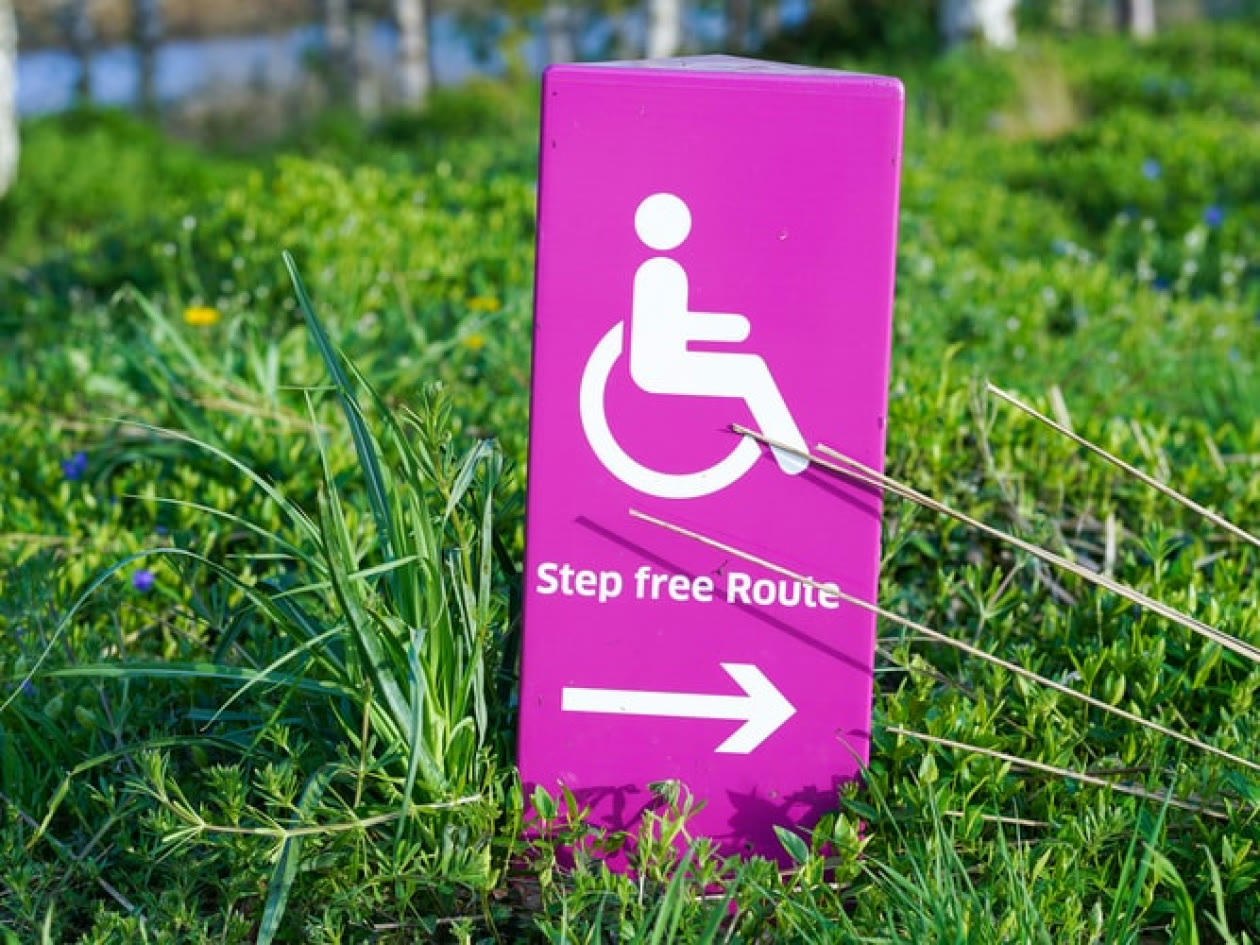
This is something that comes up a lot in Cicely's work: a building can be legally accessible and still place an enormous amount of extra labour on some of the people inside it. The gap between what a space technically permits and what it actually costs someone to use it is often invisible to the people it costs nothing at all. Step-free routes, Braille signage and audible announcements only work if they are maintained, findable, and consistent between one building and the next.
Hillary: “Did you have a hard time in high school?”
Akiko: “In my late teens, I became very aware of the difference between being low-vision and fully blind. It doesn't bother me now, but back then the gap felt significant. My low-vision classmates could read standard textbooks, but I used Braille. We couldn't share study materials or problem sets, and that made studying together difficult.”
Hillary: “Did most of your classmates go to university?”
Akiko: “Only one person went to a vocational training school, mainly to study acupuncture and moxibustion.”
Most of Akiko's classmates did not go on to further education at all. She did, studying at two of Japan's top universities before entering the job market, which is where things got complicated in a completely different way.
Even in a school built specifically for students with visual impairments, the variation in how different people receive information created real divisions. Access is not a single thing that applies uniformly to everyone in a category.
What a place teaches you about whether you belong there
Akiko went on to study at two of Japan's top universities for her undergraduate and graduate degrees, and from there into employment.
The places we grow up in teach us things, not just through what they offer but through what they assume. A mainstream school that speaks to a six year old as if she can see is teaching her something about whose presence was imagined when the room was designed. A special needs school that gives her every skill she needs but no one her own age to talk to is teaching her something else. A city that requires years of systematic training just to move through independently is teaching her something about whose movement was the default when it was built.
Akiko learned all of those lessons. She navigated all of those environments. And she kept going, which I find so wonderful and so worth celebrating.
The practical lesson for anyone responsible for a campus, a station or an office is that accessibility for blind and visually impaired people is not settled by an audit. Wayfinding, lighting, tactile paving, signage and staff awareness all shift over time, and the only people who reliably notice when they stop working are the people using them. That is why continuous, in-the-moment feedback from disabled users matters more than an annual accessibility report.
In the next part of this interview, Disability Employment in Japan: The Quota System Explained, we talk about what happened when she entered the job market, Japan's disability-employment quota system, and the question that still sits with her about why she got the job she has now.